Showing posts with label change. Show all posts

Wednesday, August 15, 2012

A Good Look in the Mirror

Women have this weird, slightly creepy habit of staring at themselves in the mirror for extended periods of time, categorizing their faults, finding new wrinkles that have appeared since their last stare session, and generally focusing on their flaws to assess what can be improved and what they need to learn to like or live with.  As a very atypical woman, even I do it.  I think it's ingrained in our genetic code.  I'm quite sure that men find this practice a little bit insane... and I don't disagree.  But it happens anyway.  Go ahead, judge me.

It's not like I can magically turn back the clock to be 22 again and wrinkle free.  I currently find plastic surgery too extreme to be a viable option, and yet I find myself staring in that mirror contemplating what can be improved upon, what I might be stressing over that's not really worth the effort, and what is a permanent change that I need to learn to accept.  What the hell is going on with my skin?  Why do I look like a teenager going through puberty this week?  Is that a gray hair?  Ugh.  With my hair in front of my shoulders I resemble a cocker spaniel.  I really need a haircut.  And so on.

I also take inventory of my personality this way.  Was I too rude to someone at work?  Should I consider changing the way I interact with another person in an attempt to get better results?  Am I really doing all the things I think I am to accomplish my goals or am I slacking and not being honest with myself?  Do I really understand the personality of an individual or am I missing an important piece that's hindering my interactions with them?

Perhaps it's my introverted nature and need for self evaluation.  Perhaps it's my competitive drive wanting to be the best "me" I can be.  It's often not a fun and affirming process.  I often find that it's not the other person that needs to adapt, but I could be doing more to make the relationship more rewarding for both sides, more effective in a professional capacity, etc. Sometimes I decide it's worth the effort to work on myself, sometimes it's not.

It's never kind to one's ego to admit you're in need of improvement.  But unlike wrinkles or the fact that your left ear is a little bit higher than your right, making your sunglasses always appear crooked on your face, you can always improve your interactions with others... if you're willing to admit you might not be doing it right. 
Admittedly, it's much easier and more convenient to place blame on others.  Especially if you're already accomplished in life, you've enjoyed a position of power for any length of time, etc.  History tells you that you've done a lot right and you've earned your position of having others ask you what to do.  But if you look at a broader history of the world, arrogance is usually a contributing factor to the downfall of leaders, civilizations, empires, governments, etc. 

I'll be staring in the mirror tonight.  Will you?

Tuesday, August 14, 2012

I am NOT a People Person

I have an uncle who has an amazing gift for gab.  He can walk up to anyone in a room and within 15 minutes they're best friends.  People feel at ease around him, and he genuinely seems to enjoy being around a wide variety of personalities.  I watch in awe as he walks around a room, engages complete strangers, and walks away with new friends that genuinely want to see him again.  It's a talent that eludes many of us, and is virtually impossible to explain how one goes about doing it successfully.

I can say without a doubt I do not share that characteristic.  In many ways I'm envious (benign envy?) of his obvious talents.  Professionally and often socially, I am at a disadvantage.  And no matter what self help articles or professional networking advice types tell me, it does NOT get easier with practice.

Unless I'm paired with an extroverted, inviting person, there are many awkward silences.  Conversation does not flow freely, and I know it's evident that my attempts at asking polite yet interesting questions is labor intensive.

I suppose I'm more British than American in that I am terrified of asking that one seemingly safe question and getting the bear trap answer.  I see a wedding band, so I think to ask if they're married and for how long, but I don't because I'm afraid they're going to respond by telling me their spouse died in a horrific car crash two months ago.  Or if they have any kids to hear that their teenager just got hauled off to rehab for the third time yesterday.

Or worse, I get stuck talking to someone I can't stand within five minutes.  As terrible as I am at forced social interaction, I'm even more terrible at hiding my feelings.  If I think someone is arrogant or egocentric, or just plain dull then my facial expressions and follow up questions are guaranteed to give me away.  I'l  let you imagine how that works out at industry functions.  I don't mind people disliking me, in fact many times I prefer it.  I just don't like potentially costing my company business because I can't fake a smile at the appropriate time.

I hate the open setting more than any other because I have zero clues to guide my conversation until I start talking to them.  If I meet them at their office, I can cheat and look for family pictures or evidence of hobbies, etc. and I can swing those meetings pretty well without looking like an inept buffoon.

Alas, I continue to put myself in situations where I end up leaving an event sweating, completely drained of energy, and very much wanting to crawl into a cave to avoid all human contact for at least a week.  I have an alumni event later this month that I'm forcing myself to attend.  I keep hoping that something eventually clicks and the whole process becomes a little bit easier.

Because in the end, I can't do this job or even my dream job successfully without being able to cleverly fake my way through a room full of strangers and leave convincing at least one of them that I'm personable and charming.  I keep watching my uncle in awe, but I can't take him with me to these things--I know I'd let him take the lead because it's so much easier.  And that will get me no where.

I don't have to start enjoying it--that would be unrealistic because dealing with people in general will always be "work" for me.  I just need to get to the point where people can't tell that it's work.

Thursday, August 2, 2012

Walking Around Upside Down

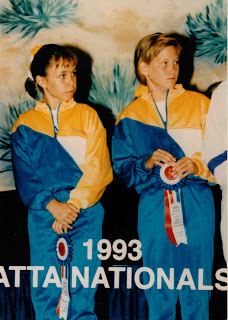
Me and my partner taking 5th at Nationals for synchronized trampoline
The Olympics' coverage of women's gymnastics is always bittersweet for me.  I enjoy watching it because it's rarely given decent coverage the other 3 years (seriously--I think they only air it on ESPN "the Ocho") and I spent 11 years within its depths.  I see the mistakes that the average viewers miss, I know the proper names of the tricks, who they were named after, and I know the track record and medal count of many of the gymnasts going back to Nadia Comaneci in the 1976 games.

Gymnastics is a unique sport.  It's highly individual, yet they force a team aspect out of it.  It's incredibly repetitious yet constantly asks you to take huge risks.  It's physically brutal yet the mental aspect can cost you more than a failed joint.  It's full of contradictions, snap judgments, and double standards.  Coaches, gymnasts, and judges can play extremely dirty and the stories about children being put through what many might consider a form of torture are rampant (and often not unfounded).  Countless kids have had genuine breakdowns by the age of 12 under the pressure of competition, leaving the sport for good, cursing the lasting emotional torment it's left in their lives.

And yet, for 11 years I absolutely loved it and was engrossed in the life.  I didn't leave because of an injury, a mental breakdown, or even because of the time I got screwed out of medalling in my first Nationals.  I left because I somehow lost the favor of my coach--he began taking his personal problems out on me and over the course of 6 months or so I began to seriously question whether or not I was prepared to make the personal sacrifices necessary to get to that next level.  Because that next level was to move into that world of the Elite gymnast--where home schooling is the norm to work around 8 hour a day practices, compete not just around the state and country, but around the world, and compete against girls who could sometimes be 6-8 years older than me with the same extra years experience in competitions.

To this day, I often wonder if things would have worked out differently had my coach not found a new "favorite" on the team.  Would I have questioned how much farther I could realistically go?  Would I have started wondering what a "normal" life would be like?  Would I have lost my passion and dedication?  Would I have to wait for that career ending injury and following surgeries to make my decision for me?  I'll never know, but these questions still linger.  Unfinished business.  Possible life altering mistakes that I have lived with for almost 20 years.  No, the questions don't fade with time.

I do know that I put all my medals and ribbons in a shoe box and didn't look at them for a couple years.  They're still in that same shoe box today.  I took down all my posters of other gymnasts I idolized.  I put every reference to the sport out of my room, and I refused to watch it on TV for a while.  The decision to leave tore me up inside, the way very few things in life can do. I defined myself as a gymnast and now suddenly had to start from scratch on figuring out who I was as an individual.  I was 14 years old and didn't know what it was like to not immediately go to the gym almost every day after school.  I had only a handful of friends who weren't gymnasts.  I had very little to relate to my peers with because I was behind on movies, music, cute boys, and even the cool stuff to wear because all of my focus was dedicated to gymnastics or getting good enough grades so I could keep doing gymnastics.

The kind of gymnastics I flourished in wasn't your traditional all around with beam, bars, vault and floor.  Although that's where I started at the age of 3 in a program called Kinder-lites with my first coach Mrs. B.  My parents were looking for an outlet for my energy--and I found sanctuary.  We moved three years later and found a local gym--the head coach had been a former assistant to Bella Karolyi.  I was star struck--a real link to Mary Lou?  How could I not be?  I still remember try outs to make the competitive team at 6 years old.  I made it--and the prize was my very own "belt" with my name in purple, the color of the mighty Titans to which I now belonged.  I cherished it and wore it proudly EVERYWHERE.  I remember various coaches--Cheryl, Ed, Kelly, and Raymond, the team head coach.    One of them was not so nice in their coaching style and made some of those torture rumors ring a little bit too true.  But that coach got results and quickly ruled out the mentally weak--so it's difficult to say it wasn't effective.

I competed, I placed, and I got to a point where I wasn't going to advance anymore in that gym.  So, not being too emotionally attached at that point, I left for a year and started playing soccer.  Turns out I wasn't very good at it.  I didn't have the natural ability like I did in gymnastics.  So fate intervened a little--I attended a soccer friend's birthday party at a gymnastics center.  But this was something called Power Tumbling and sanctioned through the ATTA (American Trampoline and Tumbling Association--and now seems to have become a part of the USGA).  Instead of a square floor, there was a bouncy strip you tumbled all the way down--no dance moves.  Instead of bars and beam, there was a trampoline you did a routine one instead of tested new tricks.  The coaches hosting the party were coaxing me to do some of my old tricks and I was like a duck in water.  They asked me to join their team that day.  How could I refuse?  I was reinvigorated.  I was a mediocre soccer player at best, and I knew I had the chance to be truly great at this.

In the span of two competition seasons, I managed to move from Novice to Advanced.  I was having fun.  I had learned more new tricks in two years than I had in 6 years of all around.  This was where I belonged.  My mom diligently took me to fabulous destinations like Lawton, OK for meets.  And then, in 1992, I qualified for my first Nationals.  There I lived a gymnast's worst nightmare.  I fell on my face in my first event, killing any hopes of being on the podium.  But I still had two more events to go and I had to pull it together for those.  I pulled off my routines, but they weren't good enough to medal... or so I thought.

When I went to check my posted scores to see how I did, my mom noticed the math didn't look right on one of my events.  She pulled out a calculator to double check, and yes, they had shorted me two full points and the correct score would have put me in 2nd place and qualified me to go to the World Competition in that event.  She went to the judges, argued, was denied, argued some more, found the people running the event, argued with them--and all of her effort went in vain.  The math error cost me a medal at my first Nationals and a chance to compete representing Team USA.  I was devastated, angry, and determined to not let it happen again.  I felt cheated--so much more so than I ever did in all around where they would deduct points if your hair got out of place during your floor routine.  Because some idiots couldn't double check their math, I missed out on the opportunity of a lifetime.  It was my equivalent of an Olympics and I'd been robbed.  Now I'd have to wait two years for a chance to make Worlds again.

1993 led me back to Nationals and my first international stage, the Indo Pacific Games.  But that's also the season where it fell apart.  My coach at the time, Chad, started having relationship problems with his girlfriend, pretty serious financial issues (the gym even closed a couple years later), and came to practice frequently taking his frustrations out on the team.  My teammates were no longer my best friends thanks to various changing social structures from joining the world of teen angst and what I can only assume self preservation to stay out of Chad's cross hairs.  If the negative focus was on me, then it wasn't on them.  From all sides, I was an outsider trying to claw my way back in while trying to maintain my focus on my events and routines.  It was exhausting.  I cried after going to bed many nights--I didn't want anyone to see or hear me.  I started dreading going to practice because I knew I'd get yelled at, ignored, or even ridiculed sometimes outright, with the coach joining in.

Somehow I managed to fight through it to end up finishing 5th in one event and 9th in another in Nationals--and 7th overall in one event in the Games.  I was, by definition, one of the top gymnasts in the country, part of Team USA, and the thought of going through all that another year made me physically sick.  Surprising both of my parents, I told them during the off season I wanted out.  They asked me to think about it, asked if I wanted to find a new gym, but I told them I had been miserable for months and that I didn't love it anymore.
Reluctantly, they helped me cut all ties with Chad, the gym, and they put up with my senseless drama about not knowing what to be for a while.  My mom convinced me to go through the certification to become a judge--I had to have been one of the youngest judges ever, but they allowed it because of my years of experience.  I hated it.  If I wasn't out there competing, it just felt wrong to be there at all.  Plus, seeing how subjective other judges were and how open they were about it only made me more angry about my years of being on the other side, wondering if I was being purposefully kept off the podium.

So what did I get to take away from all this once it was all said and done?  I avoided any massive, life altering injuries, which I still consider myself lucky for--it was very common to compete hurt and nothing I ever did turned into something serious.  I came away with one of the biggest competitive drives that still influences me greatly today.  I have a "never quit" attitude--which has helped me push through some tough times and made me better, but I've also stayed a part of things far too long, thinking I'm obligated to finish it simply because I started it.  I have yet to be put in a situation that I've felt was more stressful than competing on the world stage--so I'm either in massive denial or I handle stress really well.  There's good and bad that carry forward--same for the memories when I look back.

Now I'm starting to get asked if I'll get my daughter into gymnastics.  I want to let her try because, honestly, she does show some aptitude for it already.  But I'm not sure I want to let her get as involved as I did.  The one simple reason is that I still can't answer that fundamental question, "Was it all worth it?"

Thursday, July 19, 2012

One More Take on Marissa Mayer

Eve at just over 12 months
As if it hasn't been covered to death already, here's one more view on Yahoo! hiring Marissa Mayer knowing she is 6 months pregnant as their latest CEO. To be honest, I didn't know much about her when she was first announced and I didn't realize she was pregnant until the next day when the news stories flashed EVERYWHERE. It got old fast, but at the same time it is a corporate first and widely unexpected.  It struck a nerve with me personally, as a relatively new mom struggling daily with finding some kind of balance with climbing the corporate ladder and feeling like I'm not missing too much of my daughter's life.

Eve is 21 months old right now.  She's nothing short of awesome.  The worst part of my day is dropping her off at daycare around 6:45 in the morning.  Tears have surfaced on more than one occasion.  And I can't even begin to describe the gut wrenching pain of having to tell your child you have to go when they're crying and holding on to you not wanting you to leave.  The best part of my day is picking her up between 5:30 and 6 depending on traffic.  She's always so happy to see me--flashing a gigantic smile and running over to hug my legs and ask me to pick her up.  We've gotten into a sort of rhythm, but it took a long while to get to this point.  And I'm not exactly thrilled she spends a majority of her waking hours with someone other than me.

I took three months off from work when she was born.  I laid out a detailed plan on how I would work from home, slowly at first, but then ramp up so that by the second month I'd be doing my entire job from home with a few exceptions.  I thought I'd be able to get it down so fast, that while yes it would be an adjustment, it wouldn't completely turn my life upside down, and I wouldn't lose too much ground professionally.

Wow, was I wrong.  I couldn't believe how much I'd underestimated motherhood would impact my professional life.  First off, where I'd been extremely career driven before, I'd found that I preferred spending time with my little baby.  I was so anxious to see what new thing she was going to learn each day, when she'd hit the baby milestones.  Watch all of her firsts.  Suddenly the after work drinks to network didn't appeal to me.  I'd rather be home with her.  I continue to struggle with the guilt of missing so much of her day and only getting to spend a few short hours with her in the evenings before she goes to bed.

Second, I nursed.  For an entire year.  It was extremely important to both me and my husband that we give her the best nutritional start we could.  I'm proud of it, but try scheduling meetings or taking phone calls or even planning to attend an event after work around that schedule.  To keep things flowing (so to speak) you have to pump about the same time your baby would be taking her usual meal.  So three times a day, I shut my door for about 20-25 minutes and focused on answering emails or doing reports and other paperwork.  Yes, I researched how to make my pump "hands free."

Traveling was difficult to say the least.  I managed to make a few day trips and a couple of 2 and 3 night stays at various times, but then that meant pumping 4-6 times a day, making sure I had a refrigerator/freezer to store it in my hotel room, and then transporting everything back and forth on airplanes with freezer packs.  But I also avoided more than one trip because it was complicated and again, I wanted to be home.

Add on top of it, how much more difficult it would have been if my husband hadn't been so understanding and supportive of my career, stepping up to play Mr. Mom while I was gone.  But that also means his career has the potential to suffer as well.  If I'm out of town, and he gets the call that Eve has a fever, he has to drop everything to go pick her up and take her to the doctor.  If she's sick for more than a day, one of us has to stay home with her.  All of that is time away from work when others are there.

Now back to Mrs. Mayer.  She'll be a first time mom--is she also underestimating the insanity that is motherhood?  Obviously, she's in a financial position to have full time help should she want it, but will she grapple with the ever present "mommy guilt" the same way I do?  Will Yahoo! and more importantly its investors and analysts be understanding of a flexible work schedule when it comes to the stock price?  Will the Board continue to support her and how she wants to run the company if they start to feel the frequent pediatrician visits or calls about a sick child are interfering with the company's performance?  She's not exactly taking over the most stable company--and turning a company around is a lot more demanding than keeping one on a smooth sailing course.

Personally, I hope she's some kind of miracle CEO that turns Yahoo! into a relevant player again.  I hope she's able to find that balance where she's comfortable with the sacrifices she makes at home and the ones she makes at work.  Because without question, both will have to happen.  I hope she's fulfilled personally and professionally.  And I hope that she doesn't mind that professionally ambitious moms everywhere are looking at her in hopes that a very public success story will help pave the way for their own success.

Wednesday, July 18, 2012

The Generational Change Gap

This is a sensitive topic, as I'm voluntarily walking into the bear trap of being that stereotypical, younger whining twit who thinks old people just don't get it, man.  Even more so when I disclose that I work for a company that's run by my family.  But that doesn't make it any less of a real issue.  I've spent more time editing this one than I did writing it, and I hope my attempt to remain objective and not get personal reflects that.  If not, feel free to argue with me and point out where I'm wrong.

There are times when I avoid our almost 79 year old Chairman of the Board.  And those days where I get sucked into something, well, they're often filled with more headaches than solutions.  Unfortunately, he really doesn't understand what I do.  Much of what I'm involved in simply didn't exist in his heyday, and while they're critical now, they weren't for many years and I know he has trouble seeing the value I bring to the bottom liine.  I've been introduced to various people he has tour our office as "my oldest granddaughter... I have no idea what she does on that computer all day, but she sure looks pretty doing it."  I think he means this as a compliment, but there's very little I find more insulting professionally.  So I do what I can to get my job done without his interference.

It's sad, and I'm sure the company as a whole is missing out on some benefits it would otherwise gain if there were a way we could work together more productively.

This dread and swelling urge to roll my eyes is often misconstrued as a general disdain for the older generations. I find myself right in the middle of that over lap between Gen X and Gen Y (I tend to self identify more with the Xers) but neither generation are well known to view the baby boomers or WWII generation with the greatest regard when it comes to business.  However, at least for me, there are two very distinct types of of these "older business types" and while I do often find one group incorrigible, I genuinely feel the other gets a bad rep from their counterparts.  The result is, and I'm just as guilty as the rest, we tend to ignore the wealth of knowledge they could constructively provide.

The first group I'm referring to has the mentality of management by walking around, their ways of doing business are the only ways, and you can't possibly get any work done if you're not in the office. They tend to look at younger generations as soft, spoiled, maybe even a little inept.  They come across not as attempting to impart their years of wisdom (which they do have, I must give credit where it's due) but more as a parent using the "tiger style" approach on an unruly child.  These are the CEOs who, despite several studies and articles that speak to the contrary, will make every attempt to kill social media usage while their workers are on the clock because they think it destroys their precious productivity.  They tend to show too much favor toward one aspect of a business as the critical department that determines a company's success or failure (not a coincidence, it's often the department they came up through to their current prominence).  They force their ideas down the throats of those who report to them instead of granting those people the freedom to make a critical decision.  They scoff at innovation and can be overheard saying something similar to "that's the way we've always done it" or "this has worked for me for 30 years, I don't see how you can't make it work now."

From my perspective, it's very easy to see why I may come across as unwilling to listen to the "olds" overall.  However, some of the business people I look up to most include Warren Buffet, H. Ross Perot, Richard Branson, and Jack Welch. They're not perfect but they have one very critical thing in common.  Here's the simple idea that creates a massive divide between the people I rather harshly described before to make a point and these gentlemen--they embrace and cultivate change. They're intelligent enough to know they don't know everything and look for knowledge and ideas at every possible turn. 

It seems like such a simple concept to me and many among my two generational groups yet it's amazingly difficult to get older generations to use in a business setting. I'm not sure of the motivation behind this behavior but I certainly find myself speculating--are they realizing they're approaching the end of their "useful life" in the business world and they feel a little resentment toward feeling cast aside?  Are they convinced this "new" business model is all wrong and will only result in our impending fall into some sort of zombie apocalypse? There are a myriad of potential explanations, but whatever the truth is (and it's probably different for each of them), they hold to it like the world will end if they let that idea go. 

Yes, change is uncomfortable and sends you out into the world not knowing how it will turn out.  Yes, change may reveal that you're no longer as astute as you once were in business.  Yes, change can be extremely difficult and can make you feel incredibly unsure of your professional future.  But the "ah ha" revelation that should go with those fears is change is no different for someone who is 65 than it is for someone at 25.  It scares all of us.  No matter your age, experience, your knowledge, or even your chosen profession and your rank within it, change means you have to adapt, continue learning, and is essentially a lot more work than going with the status quo.

But even the Greek philosophers (who are literally as old as dirt by now) almost preached that the key to life is to never stop learning.  Plato said, "If a man neglects education, he walks lame to the end of his life." There may no valid reason for you to take heed of what I think or say, however, I've always heard this Plato guy was pretty smart. Hopefully you'll at least consider his words and embrace the small difference in your attitude that can literally transform your legacy, your impression you leave with the younger generations you lead today, and create an opportunity to impart the infinite wisdom you do have to share with the world. It's not necessarily what you say but how you say it and how you respond to others, but that cliche is for another story....

Wednesday, July 11, 2012

Read Me

What's the point of this blog you may ask?  I haven't quite figured it out yet.  But I feel compelled to build some sort of writing portfolio to see if my lifelong yet frequently ignored hobby of writing could ever turn into something more.

I've gone back over some of my personal writing and realized I've complained about not doing this for years now, so it's time to stop complaining and start doing.  If it ends up being a fruitless endeavor, then at least I can say I tried.  I don't want end life thinking that it's okay to just muddle through without ever really taking a chance on something one loves.

So here it is.  I'm open to criticism (as long as it's genuinely useful--if you want to heckle, I must warn you I can sling it with the best of them).  I'll probably cover a wide variety of topics and it may seem like I'm all over the map, but I have a feeling I'll start converging on a theme or two most important to me as I continue to write.

I need to commit to this before I wake up one morning not recognizing the potential I once had.  I've been joking about writing that NY Times best selling novel for over ten years.  I've jotted down at least 15 story ideas.  I'll be throwing down during Nano Wrimo this year and really making an attempt to finish a complete draft.  I've started a few, but never finished one.

I want to write.  Despite all the articles and blogs telling the masses to never become a writer.  All the articles and blogs that speak of the boundless rejection, the impossible odds to overcome, blah, blah, blah.  I take them in and genuinely consider whether or not I should quit this silly idea and something always pulls me back.  If it's meant to remain a hobby, I can live with that.  If it's meant for more then I can't allow myself to never take the chance.